Last updated: August 2026
The Plotliner
A seven-sentence story spine you can hear before you write the pages.
Your story needs a spine. Not a scene list, not a treatment, not ninety pages of notes you will never reread. A spine—the thing that holds the rest up.
The Plotliner has two parts. The throughline gives your story meaning. The plotline gives it a spine. This page stays with the spine.
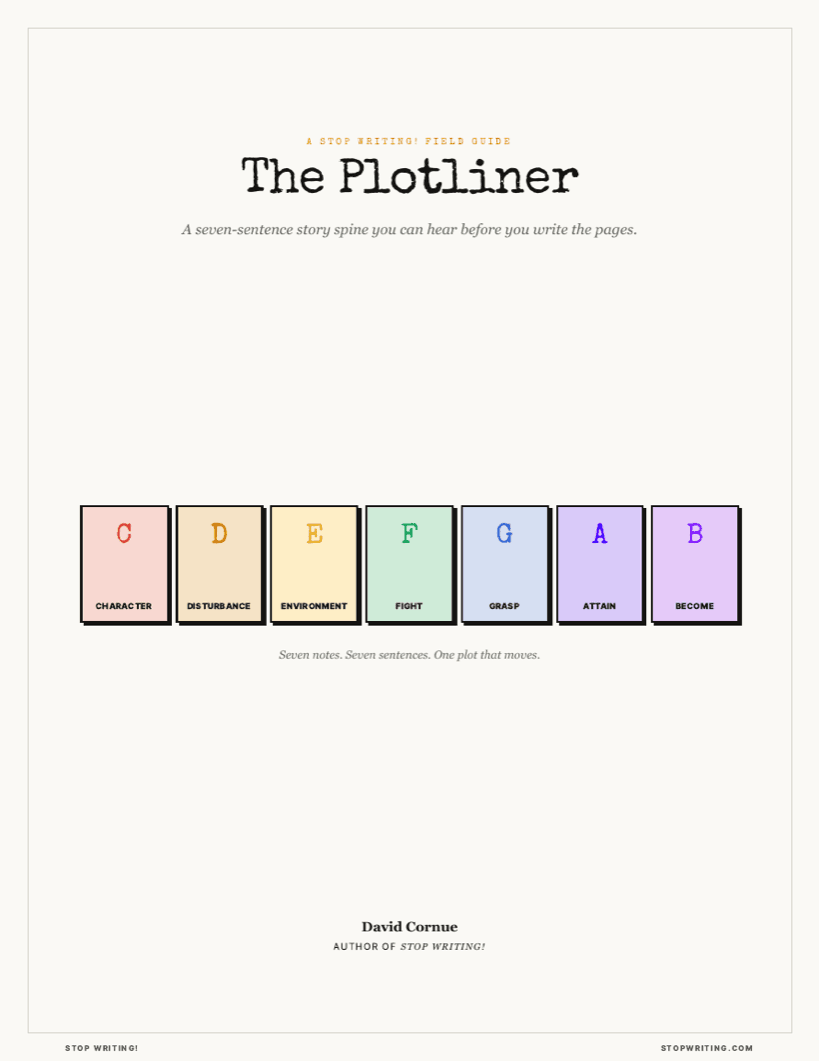
Write the plot in seven sentences, one for each note: C, D, E, F, G, A, B. You are not outlining every scene. Each sentence marks a turn. Put the seven turns in order and you can hear where the plot moves, where it stalls, and where a piece may be missing.
Seven notes. Seven sentences. One plot that moves.
Why seven notes?
C-D-E-F-G-A-B is inspired by the C major scale. It comes from the Story Scale, an underlying method I use across several tools in the book, including the Plotliner. Here, those seven notes form the story’s spine. Story Scale shows you the shape of a story that already exists. The Plotliner builds yours.
The seven notes
Use each note to write one sentence. These are prompts, not a scene list.
the protagonist
Who is at the center, and what do they want before trouble arrives?
the inciting incident
What breaks the old life and creates a before and after?
the new world
What new world must they enter because of that break?
the challenge
At the midpoint, how do they meet the force against them?
the learned lesson
What do they gain, learn, or choose that changes the contest?
the achievement
How do they attain the goal through a surprising turn?
the transformation
Who are they after the pursuit has changed them?
Your turn
Start with the note you can see. Leave a blank when you need to—a hole you can name is worth more than a sentence you forced. Read the finished spine from C through B. No scenes. No polish. One sentence per note.
The test: THEREFORE
Read the seven sentences aloud. Put one word between each one.
Read sentence C. Say THEREFORE. Read sentence D. Keep going through B. If THEREFORE sounds false, the handoff is loose. That is the place to work. Find the weak connection, ask what cause is missing, and rewrite the two sentences on either side of it.
THEREFORE does not belong in the finished story. It belongs in the test.
That is the spine
Seven sentences can tell you whether the story moves. They cannot tell you everything the story means. That is where the rest of the Plotliner begins—the throughline, the structure beneath the seven notes, and full worked stories. The spine tells you what happens. The rest of the method helps you discover why it matters.
Starting a new story? Print page four, write one sentence per note, and read it back from C through B.
The Plotliner is one tool. The book is the whole method.