Commend. Clarify. Consider.
Three steps for giving feedback that strengthens a story instead of flattening it.
Someone handed you their story. That’s an act of nerve — and a quiet terror. They’ve brought you their brainchild the way a parent brings a child to a doctor, braced for you to find something wrong.
Most feedback wrecks the work it means to help. The temptation is to rewrite the sentences so they sound like yours, to pick the story apart to prove you’re smart, to mistake “I would have done it this way” for “this is broken.” Good intentions, bad outcome — the writer walks away more lost than before.
The Three Cs fix that. Give your notes in one order — Commend, Clarify, Consider — and you become a collaborator, not a critic. You protect the one thing a story can’t survive losing: the writer’s voice.
1. Commend — give compliments.
Start with what works. Always. Lead with the wound and the writer stops listening. Lead with what’s alive on the page and they trust you with the rest. This isn’t flattery. You’re telling the writer which instincts to keep.
2. Clarify — ask questions.
Now ask. Don’t tell. When something confuses you, put it as a question — “Can you explain why she stays in this scene?” — not a command — “Cut this scene.” A question hands the problem back to the writer, where it belongs. They know the story you don’t. Your job is to show them what’s unclear to the rest of us, not to write it for them.
3. Consider — offer considerations.
Last, offer. A consideration is a door, not a directive: “Consider starting later in the scene.” Take it or leave it. The moment you insist, you stop reading the story and start rewriting it — you become a Voice Thief, trading the writer’s voice for your own. So help the writer go deeper into what’s already on the page. Don’t bolt on what isn’t. Drill in. Don’t add on.
The margin marks
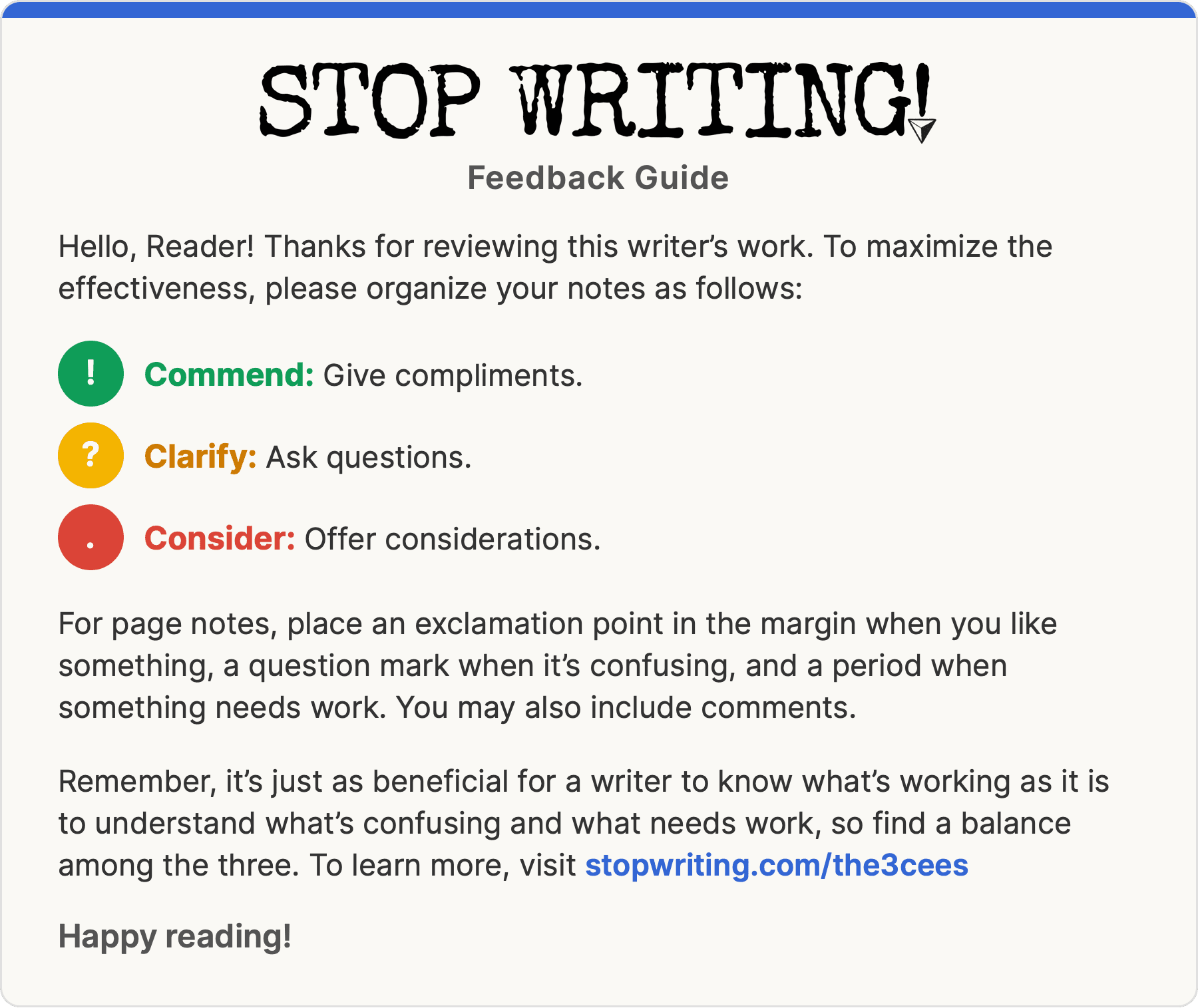
Reading on the page? Three marks do the whole job:
- Commend — where something works
- Clarify — where you get confused
- Consider — where something needs work
Want the full resource library?
Free story development guides from the Stop Writing! method. Drop your email and I’ll send them over.